
Give to Gain: The Leadership Multiplier in Modern Finance


Give to Gain: The Leadership Multiplier in Modern Finance
Working closely with CFOs across a range of sectors, I’m reminded that the most influential leaders are not defined solely by technical excellence or commercial acumen, but by how they show up for others.
This year’s International Women’s Day theme, Give to Gain, captures something I see repeatedly in executive search. Leadership is not a zero-sum game. The CFOs who create the most value are not those who guard information or influence, but those who give their time, sponsorship, advocacy and belief. In doing so, they build stronger teams, more resilient organisations and more sustainable success.
Reflecting on what Give to Gain means through their own journeys, I asked several finance leaders to share their perspectives, revealing how generosity in leadership is both deeply personal and commercially powerful.
Leading with belief
As a Chartered Accountant working at the intersection of finance leadership, AI and emerging operating models, Heather Osborne brings over 20 years’ experience across FTSE100, NYSE-listed and global financial services organisations, including roles with KPMG and Deloitte. Her work now focuses on how the role of the CFO is evolving as organisations move toward intelligence-enabled operating models and increasingly mutable workforces, where technology reshapes how decisions are made, how teams collaborate and how value is delivered. With a strong focus on translating strategy into measurable outcomes, Heather is known for building high-performing finance teams rooted in trust and belief, combining deep technical expertise with a deeply human approach to leadership
For Heather, Give to Gain is not simply a theme, it is a principle she has consistently lived throughout her career.
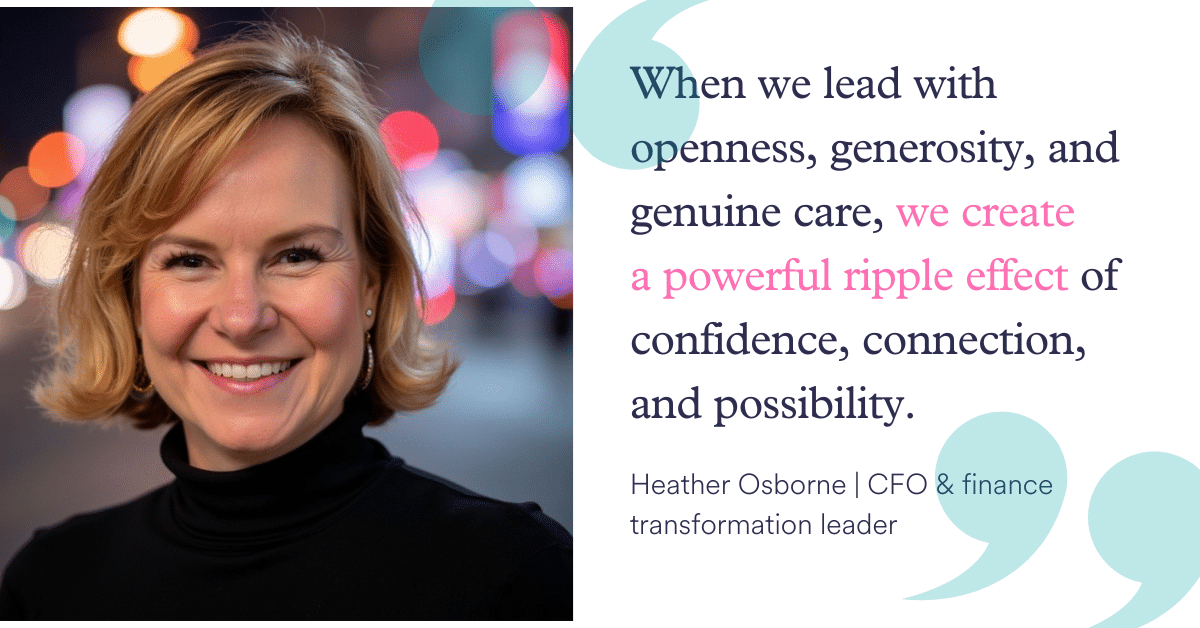
“The Give to Gain theme stopped me in my tracks because it names a truth I’ve lived throughout my leadership journey: giving is not loss – it’s multiplication. Early in my career, a book called Excuse Me, Your Life Is Waiting by Lynn Grabhorn got me thinking about leadership. It taught me that ‘the way we feel is the way we attract’. That insight matters deeply in leadership, because people don’t just hear what we say – they feel how we show up. When we lead with openness, generosity, and genuine care, we create a powerful ripple effect of confidence, connection, and possibility.
“I believe the greatest gift you can give someone is your time, and I give it wholeheartedly. It fills my cup to see the moment self-doubt gives way to belief – when someone realises, ‘Hey, I can actually do this’. I choose to meet people with the intention of love, because people don’t want to feel like numbers – they want to feel cared for. When women are given space to be seen, heard, and safe enough to speak up, diversity breeds richness and outcomes improve. Seeing women rise, challenge and win in the boys’ club, and lead in their own right energises me – and it reinforces my belief that when we give with open hearts and minds, we gain a more connected, courageous, and equal world.”
Heather’s reflection reinforces something I see often: when leaders give belief and psychological safety, performance follows. When people feel seen and valued, they step forward.
Creating space
That theme of stepping forward and enabling others to do the same is echoed by Gwynneth Page, a commercially astute finance leader and Fellow of CIMA whose career spans FTSE 100/250 organisations across manufacturing, engineering, marine, technology and nuclear sectors. Starting out as a Chartered Engineer at BAE Systems before transitioning into finance, Gwynneth brings analytical rigour and strategic clarity to complex, performance-driven environments. She has earned a reputation for delivering impact while strengthening the teams around her, and her understanding of Give to Gain reflects that experience.
“Drawing on my journey from engineering into finance, the Give to Gain theme resonates deeply with me. Throughout my career, saying yes to stretch opportunities, investing in my own development, and championing others have been the catalysts for progress – not just for myself, but for the teams and organisations around me. Resilience, clarity, and a commitment to empowering others have shaped my leadership style, especially while navigating male-dominated spaces.
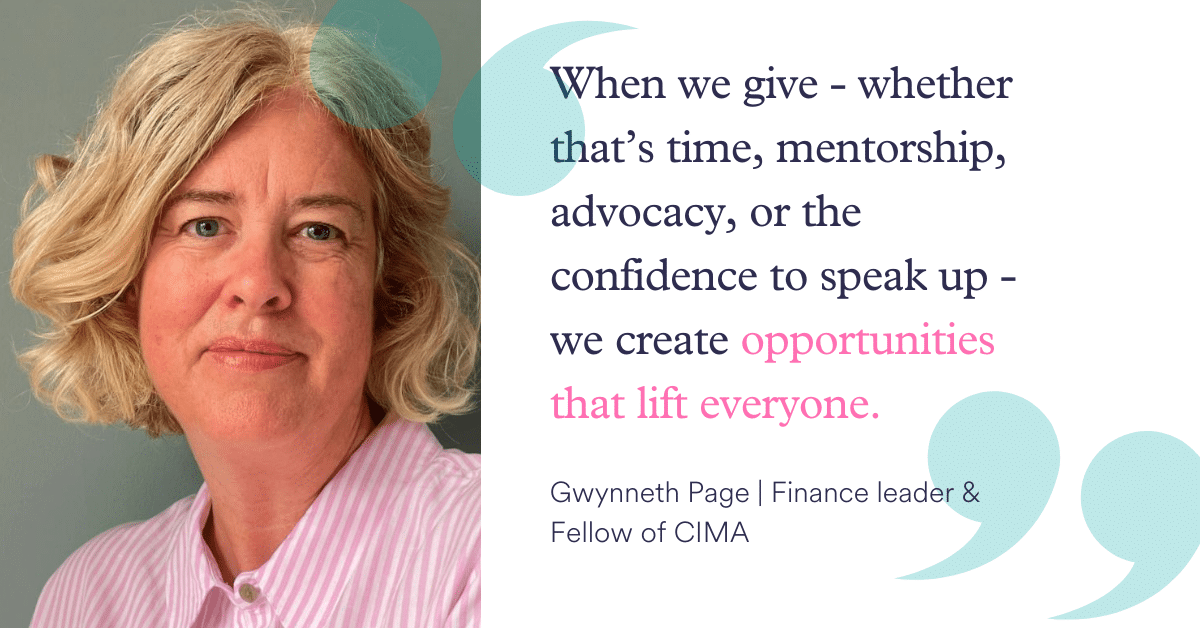
“When we give – whether that’s time, mentorship, advocacy, or the confidence to speak up, we create opportunities that lift everyone. International Women’s Day’s call of ‘Give to Gain’ is a powerful reminder that by sharing our knowledge, raising others’ visibility, and creating space for women to lead as themselves, we collectively build a more inclusive and equitable future.”
Gwynneth highlights that giving is intentional. It requires conscious decisions – to mentor, advocate and share visibility. Leaders who expand opportunity strengthen the entire organisation.
Equitable treatment with flexibility
But intention alone is not enough. Subtle behavioural dynamics still influence how performance is perceived – particularly in how men and women communicate their ambition and capability.
Zoe Mansell, CFO and transformation leader with 28 years of experience driving financial strategy, M&A, business integrity and operational excellence in software, SaaS, and professional services, brings a sharp lens to this often overlooked dynamic.
Known for designing-never-before-seen product solutions, coaching businesses on back-office tracking and data structuring to get ahead in high growth, Zoe combines commercial discipline with people-centred leadership and has a particular interest in how communication styles influence progression and equity at senior levels.
“In pursuit of gender equality, leadership needs to have a flexible approach as the key point remains that even though all people are different, there are still certain traits that typically vary between men and women. These differences continue to impact the route through annual reviews and promotions, as each gender approaches the vocalisation of their own performance differently as well as relationship feedback from the wider business.
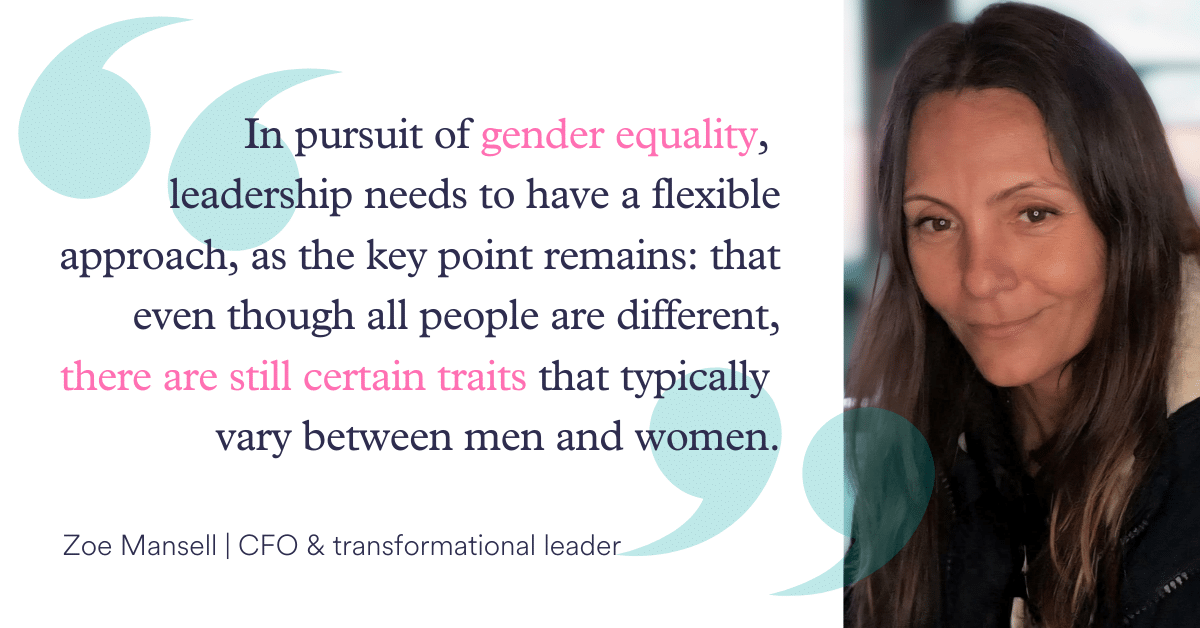
“A common variance observed is in self-promotion behaviours. A typical female trait with a deep understanding of processes is to point out there are still more areas to learn, which has been referred to as the confidence gap between the genders, and another can be their views being seen as ambitious, where a recent survey by ITV showed that 2,000 women surveyed saw ambition as a positive trait in women at 43% but in men at 87%.
To ensure equitable treatment, various views and vocalisations in communication need to be understood and respected.”
Zoe’s perspective challenges us to look more closely at how performance is interpreted and rewarded. If ambition is articulated differently, and evaluated differently, then equity requires more than equal opportunity, it requires awareness.
Investment in infrastructure that enables women to succeed
But even when communication is understood and fairly assessed, another question remains: are the structural conditions in place for women to participate fully in leadership in the first place? Too often, women carry disproportionate caring responsibilities before they even arrive at work. Without the right infrastructure and support, talent is constrained before it has the opportunity to thrive. If we are serious about Give to Gain, organisations must build systems that enable women to participate, progress and lead without structural disadvantage.
It is from this broader perspective that Natalia Molchanovsky adds her voice. Currently working within a multinational financial institution, Natalia is a Finance Leader (ACCA, MSc in AI) operating at the intersection of finance and advanced AI, bringing insight from within the fast-evolving world of global payments and financial services.
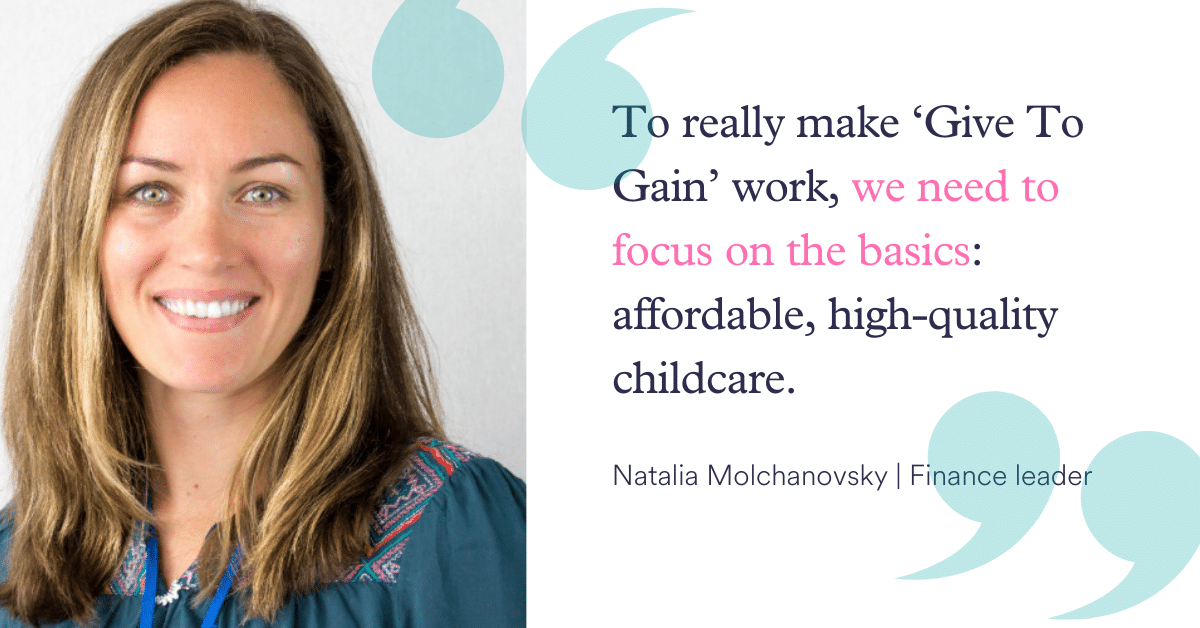
Combining deep financial expertise with hands-on AI and automation capability, she is known for embedding intelligent, compliant systems that enhance efficiency, strengthen insight and align complex financial architectures with business strategy across international markets. For Natalia, Give to Gain must extend beyond mentorship and intention, it requires investment in the infrastructure that enables women to succeed: “To really make ‘Give To Gain’ work, we need to focus on the basics: affordable, high-quality childcare. Whether it’s more nursery spaces or reliable after-school clubs, this isn’t just a ‘nice-to-have’, it’s the essential infrastructure women need to thrive.
“When we invest in these practical foundations, we aren’t just filling a gap; we’re multiplying opportunities. By giving women access to the right childcare, we gain a world where everyone has the chance to rise.”
Natalia’s contribution is a clear reminder that inclusion cannot rely solely on goodwill. In conversations I have with CFOs and boards, the pipeline challenge is rarely about capability alone – it also reflects practical barriers. Investing in foundational support is both responsible and strategically smart.
The Multiplier Effect
Across these reflections, a clear thread emerges:
- Giving belief builds confidence
- Giving visibility builds careers
- Giving opportunity builds organisations
- Giving infrastructure builds equality.
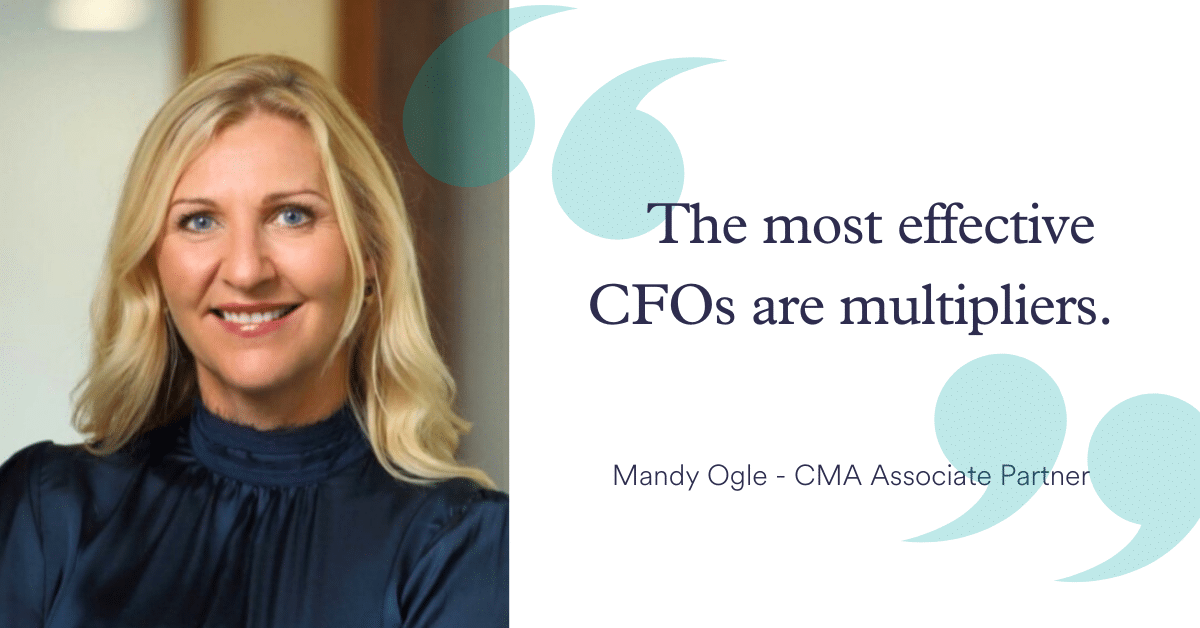
In my work partnering with boards and CEOs to appoint senior finance leaders, I see that the most effective CFOs are multipliers. They invest early, sponsor future leaders and build systems that enable others to perform at their best, elevating the strategic impact of finance in the process.
Give to Gain is not soft leadership. It is commercially intelligent leadership.
When women are given space, sponsorship and structural support, we gain stronger decision-making, better governance, more innovative thinking and more resilient businesses.
Bringing together these perspectives reinforces something I see daily: generosity in leadership is not a trade-off, it is a growth strategy. And the CFOs who understand that are shaping the future of their organisations.